
10 Best AI Task Websites to Make Money in 2026
If you’ve spent any time on Reddit or YouTube lately, you’ve seen the ads: “Get paid $30/hour to train AI.” Some of that is real. A lot of it is exaggerated. This guide cuts through the noise.
We looked at contributor reports, Glassdoor and Trustpilot data, official payment documentation, and platform help centers to put together an honest list of the 10 best AI task websites to make money in 2026: what they actually pay, who they suit, and where the real catches are. This is written for people in the US, UK, Canada, Australia, and India who want a legitimate side income, not a get-rich-quick fantasy.
One thing up front: earnings on every platform below vary by country, project availability, your qualifications, and how consistently you work. Nobody can promise you a fixed monthly number, and you should be skeptical of anyone who does.
Read More: How to Use ChatGPT Deep Research for College Assignments (Tested in 2026)
Quick Comparison: Best AI Task Websites in 2026
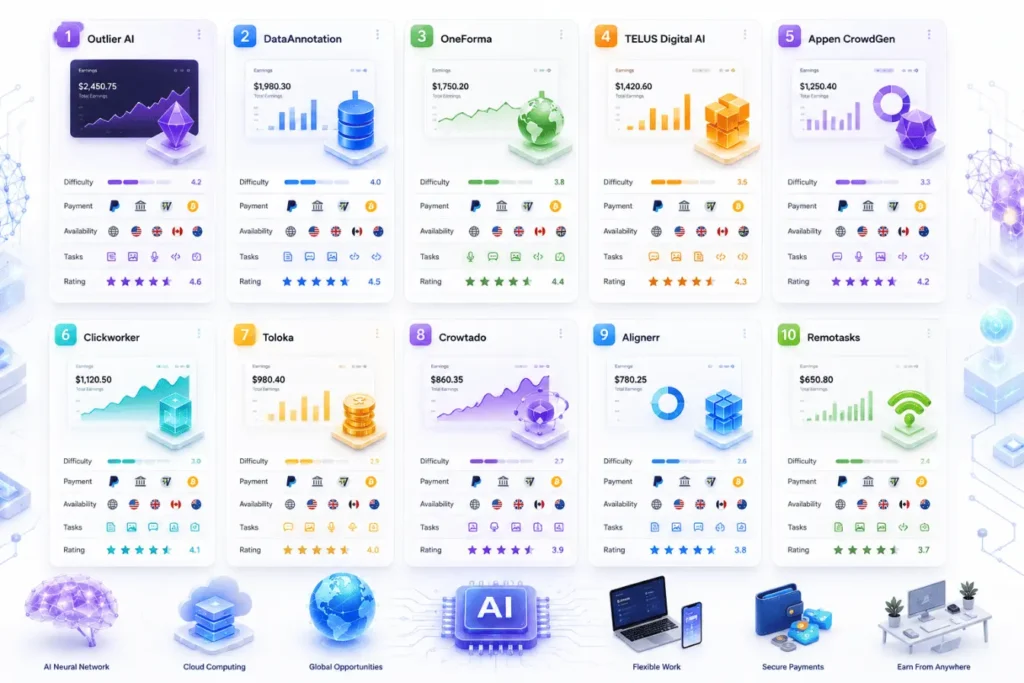
| Platform | Best For | Expected Earnings | Payment Method | Difficulty | My Rating |
|---|---|---|---|---|---|
| Outlier AI | Skilled experts (coding, law, medicine) | $15–$100+/hr | PayPal, ACH, Airtm | Medium–High | 4/5 |
| DataAnnotation | Writers & analytical thinkers | $15–$40/hr | PayPal | Medium | 4.5/5 |
| OneForma | Translation, transcription, beginners | $14–$18/hr | PayPal, Payoneer | Easy–Medium | 3/5 |
| TELUS Digital AI | Search quality raters | $10–$25/hr (varies by country) | PayPal, Payoneer, Hyperwallet | Easy–Medium | 4/5 |
| Appen CrowdGen | Global beginners, audio/video tasks | $2–$25/hr (region-dependent) | PayPal, Payoneer, Airtm | Easy | 3/5 |
| Clickworker | Absolute beginners, quick tasks | $3–$15/hr | PayPal, bank transfer | Easy | 3/5 |
| Toloka | Instant signup + expert work via Mindrift | $1–$44/hr (huge range) | Payoneer, Papara | Easy–Hard | 3/5 |
| Crowtado | Mobile-only voice/video/ photo tasks | Up to $40/hr (claimed) | Venmo, PayPal, UPI, M-Pesa | Easy | 2.5/5 |
| Alignerr | PhDs & domain experts | $15–$60/hr | PayPal | Hard (selective) | 3.5/5 |
| Remotasks | Image/video/ 3D annotation | $5–$15/hr (~$200–$600/mo typical) | PayPal, bank | Medium | 3/5 |
The 10 Best AI Task Websites to Make Money in 2026
1. Outlier AI
Outlier is run by Scale AI, one of the biggest names in AI infrastructure, and it’s built around what the company calls “Outlier Experts.” You review AI-generated responses, rank model outputs, write challenging prompts, or rewrite flawed answers depending on your background.
Best for: People with real expertise in coding, law, medicine, finance, advanced math, or technical writing. General contributors can still join, but specialists earn far more.
Tasks and pay: Rates run from around $15/hr for general work up to $100+/hr for specialized legal or medical review, with US generalists averaging roughly $31/hr. Pay is disclosed before you accept a task, and payments are processed weekly via PayPal, ACH, or Airtm.
Countries supported: Available in most English-speaking markets and beyond, though task volume by country isn’t published.
Pros: Transparent pay, real clients (reportedly including major AI labs), no bidding process, genuinely interesting work for skilled people.
Cons: Task availability swings unpredictably; some contributors go weeks without new work. Support tickets can take a week or more to resolve, and account deactivations sometimes happen with little explanation.
My Rating: 4/5. Strong pay ceiling and real legitimacy, but treat it as supplemental income, not a paycheck you can count on every week.

2. DataAnnotation
DataAnnotation.tech is operated by Surge AI, a New York-based company founded in 2020. It’s built a strong reputation in the AI training space specifically because it pays more than most comparable platforms.
Best for: Writers, editors, and people who enjoy structured evaluation work. Coding knowledge unlocks the best-paying tasks.
Tasks and pay: You’ll rate chatbot responses, write and refine prompts, test AI behavior, and sometimes review or debug code. General tasks pay around $15–$23/hr, while coding-related work can reach $30–$40/hr.
Countries supported: Primarily US-based applicants see the most volume, though the platform accepts international contributors.
Pros: Over $20 million paid out to contributors, no joining fees, a 3.7/5 rating on Indeed from hundreds of reviews, and reliable PayPal payments.
Cons: The initial assessment is unpaid and takes 1–3 hours. If you don’t hear back within two weeks, you likely didn’t pass, and there’s often no formal rejection notice. Task volume also fluctuates.
My Rating: 4.5/5. One of the more financially rewarding platforms on this list, especially if you can pass the entry assessment.
3. OneForma
OneForma is the freelancer-facing arm of Centific (formerly Pactera EDGE), a global tech services company. It leans heavily toward language, localization, and linguistic data quality work.
Best for: Multilingual contributors and people comfortable with translation or transcription work.
Tasks and pay: Translation pays $0.03–$0.10 per source word depending on the language pair. Transcription runs $0.50–$1.25 per audio minute. General annotation work sits around $14–$18/hr.
Countries supported: Global, with strong demand for non-English language pairs a genuine advantage for contributors in India and other multilingual markets.
Pros: Backed by an established enterprise company, wide project variety, accessible entry point for beginners.
Cons: This is the weakest reputation among the platforms we reviewed. Glassdoor sits around 2.9/5, and Trustpilot skews negative, largely due to account deactivations and slow support. Payments run on a monthly cycle rather than weekly.
My Rating: 3/5. Legitimate and decent for language work, but go in with modest expectations and keep records of your submissions.
4. TELUS Digital AI (formerly Lionbridge AI)
TELUS Digital is a publicly traded Canadian company, and its AI Community absorbed the well-known Lionbridge AI “search quality rater” program. That corporate backing makes it one of the more stable names here.
Best for: People who want established, low-drama work like search evaluation and content rating.
Tasks and pay: Rating search results, evaluating AI-generated answers, and annotating text, image, audio, or video content. General rater roles average around $10–$20/hr depending on country, while the newer AI Community expert marketplace pays $20–$25/hr for higher-skill English work.
Countries supported: Global, but pay varies significantly; the same role can pay two or three times more in the US than in a lower-cost market.
Pros: Real project managers who respond to email, consistent payment schedules, low scam risk given the parent company’s public listing.
Cons: Pay ceiling is lower than Outlier or DataAnnotation at the general tier, and task volume depends heavily on which projects are active in your region.
My Rating: 4/5. A dependable, unglamorous option good for people who value stability over top-end pay.
Read More: 7 Best Free Keyword Research Tools in 2026 (Tested & Compared)
5. Appen CrowdGen
Appen is one of the oldest names in AI data collection, and CrowdGen is its newer contributor portal (replacing the older Appen Connect). It’s known for a huge global reach.
Best for: Global beginners, especially outside the US, looking for audio, video, and search evaluation tasks.
Tasks and pay: Audio transcription, search evaluation, content verification, and social media assessment. Pay varies enormously by region; contributors in lower-cost countries have reported rates as low as $2–$5/hr, while higher-value projects elsewhere pay $10–$25/hr.
Countries supported: Very broad global reach, arguably the widest on this list.
Pros: Long track record, no joining fees, weekly payouts once approved, decent pay when projects match your region well.
Cons: The 2025 migration from Appen Connect to CrowdGen was rocky, with delayed payments and unresponsive support during the transition. Pay ceiling stays modest in many markets.
My Rating: 3/5. Worth having in your rotation, but don’t expect consistency.
6. Clickworker
Clickworker is a German crowdsourcing platform that mixes general microtasks with access to Microsoft’s UHRS (Universal Human Relevance System) once you qualify.
Best for: Complete beginners who want to test AI microtask work with zero commitment.
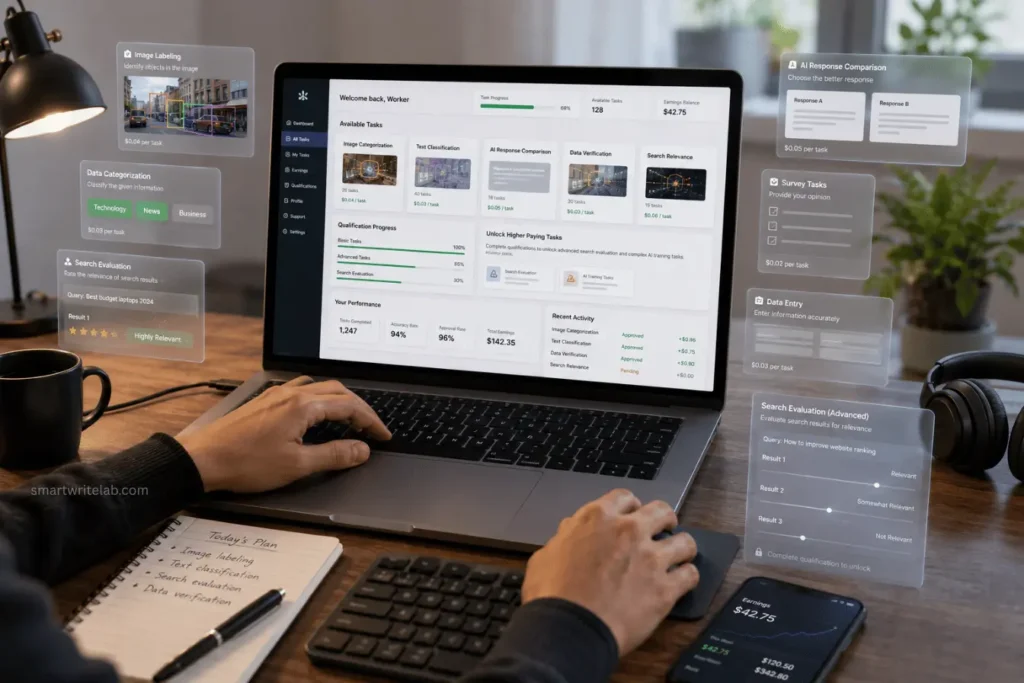
Tasks and pay: Categorization, data entry, surveys, and short AI-response comparison tasks. Standard tasks pay $0.02–$7 each and typically take 30 seconds to a few minutes. UHRS access, once unlocked, pays noticeably better.
Countries supported: Global.
Pros: Fast signup, flexible scheduling, a long operating history, and a genuine path to better-paying UHRS work.
Cons: Standard task pay is very low on a per-hour basis, and payment processing can take up to a month.
My Rating: 3/5. A fine on-ramp, not a serious income stream on its own.
7. Toloka
Toloka has operated since 2014 and is now spun off as an independent company. Worker-facing tasks are gradually shifting toward Mindrift, Toloka’s newer platform for higher-skill AI training and expert work.
Best for: Anyone who wants instant access with zero waitlist and, separately, skilled professionals willing to pursue Mindrift’s expert tracks.
Tasks and pay: Casual microtasks pay very little, often $1–$6/hr by contributor reports. Specialized work through Mindrift and UHRS-linked projects can reach a reported average of $44/hr, with top roles up to $90/hr.
Countries supported: 100+ countries and 40+ languages, though task volume is heavier in Russia, the CIS region, and Southeast Asia.
Pros: No qualification test just to start, over a decade of track record, real upside for skilled contributors via Mindrift.
Cons: PayPal was discontinued; you’ll need Payoneer or Papara. Casual task pay is genuinely low, and the platform’s transition to Mindrift has confused some longtime users.
My Rating: 3/5. Good as a zero-barrier starting point; the real money is in the expert track.
8. Crowtado
Crowtado is a newer, mobile-first platform where contributors record voice clips, short videos, and photos to help train AI models.
Best for: Mobile-only users who want simple recording tasks rather than desk-based annotation work.
Tasks and pay: Reading scripts, two-person conversations, dialect samples, short environmental video clips, and photo capture against a brief. The platform advertises pay up to $40/hr, with rates shown before you start.
Countries supported: Available in 15 languages, including Hindi, Bengali, and Urdu, suggesting solid reach in South Asia alongside the US, UK, Canada, and Australia.
Pros: Mobile-friendly, transparent per-task pay, low $10 payout minimum, broad language support.
Cons: This one needs a caution flag. As a newer platform, it doesn’t yet have the review history that Outlier, DataAnnotation, or Appen have built up, and at least one independent site-trust scanner has flagged crowtado.com with a notably low trust score. That doesn’t necessarily mean it’s fraudulent, but it does mean you should do your own due diligence, avoid sharing sensitive personal data beyond what’s needed for payment, and start with small tasks before investing real time.
My Rating: 2.5/5. Interesting concept, genuinely useful for mobile-only earners, but verify independently before committing.
9. Alignerr
Alignerr is Labelbox’s freelance marketplace, built around AI alignment and reasoning tasks rather than bulk annotation. It’s positioned as a premium, expert-only platform.
Best for: PhDs, researchers, and people with deep domain expertise in STEM, law, coding, or similar fields.
Tasks and pay: Rating and ranking AI outputs, open rewrite tasks, and multi-modal evaluation. Community-reported pay runs $15–$60/hr, with some qualifying evaluations paying considerably more.
Countries supported: Global, but the acceptance rate is famously tight; some reviewers compare it to elite university admissions.
Pros: Backed by Labelbox, an established enterprise data-labeling company; genuinely interesting expert-level work; weekly PayPal payments.
Cons: Structured as a project-by-project job board; when a project ends, you’re back to applying again. Account removals can be silent and permanent with no effective appeal process.
My Rating: 3.5/5. Excellent if you qualify and land a project, but not beginner-friendly and not something to rely on for steady income.
10. Remotasks
Remotasks is Scale AI’s contributor brand, historically known for image and video annotation. Its current status matters a lot here, so it’s worth being precise about it.
Current 2026 status: Remotasks is still active, but the platform has changed shape. Since 2024, Scale consolidated its text and code training work under the Outlier brand, leaving Remotasks focused on image, video, lidar, and 3D annotation. Simple entry-level tagging work has also shrunk as basic annotation gets automated, so remaining tasks skew toward more qualification-gated, complex work. Availability has also been inconsistent by country. Remotasks shut down entirely in a handful of countries in past years and has periodically closed new signups elsewhere, though it remains active in markets including the US, UK, India, and others as of 2026.
Best for: People specifically interested in image, video, or 3D/lidar annotation, or existing contributors with an established account history.
Tasks and pay: Typical reports land around $5–$15/hr, translating to roughly $200–$600/month for regular part-time effort.
Pros: Backed by a well-funded company, real task volume still exists, and the platform has over two million registered contributors.
Cons: Country access can change without much warning, entry-level work has thinned out, and Trustpilot ratings sit low (around 2.2/5) in recent snapshots.
My Rating: 3/5. Still legitimate, but check current availability in your country before counting on it.
Which AI Task Website Pays the Most?
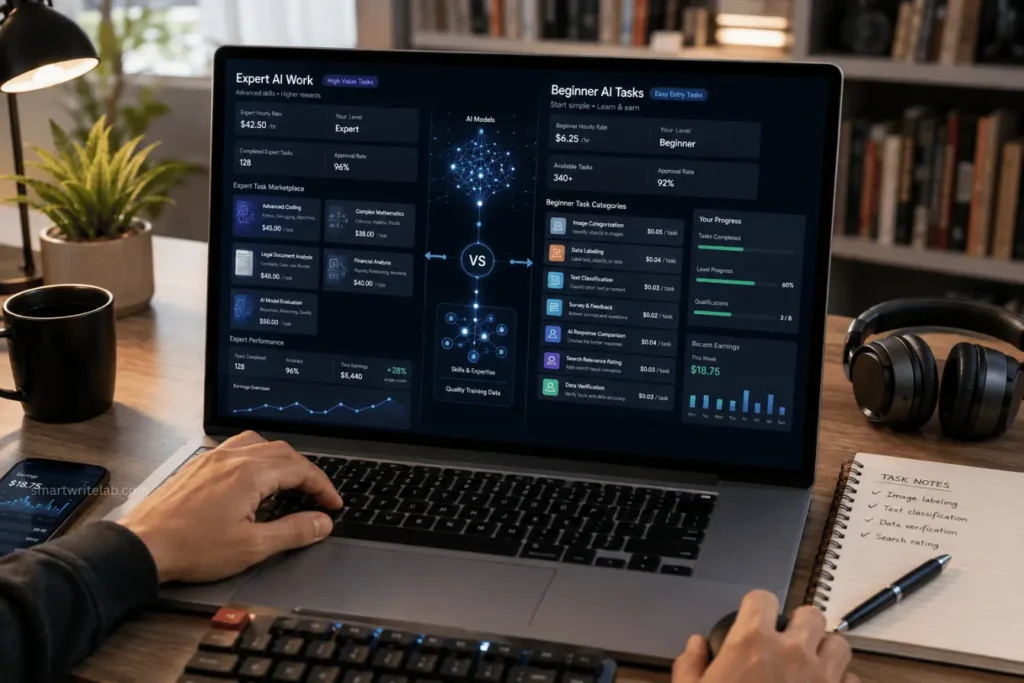
For pure hourly ceiling, Outlier AI and Alignerr lead the pack, with specialized contributors reporting $60–$100+ per hour on domain-specific work. Toloka’s Mindrift track can match that for the right skill set.
That said, “highest pay” and “most reliable pay” aren’t the same thing. DataAnnotation’s $15–$40/hr range is more consistent for a wider group of people, which is why it edges out the higher-ceiling platforms in overall value for most contributors.
Which AI Task Website Is Best for Beginners?
Clickworker and Toloka are the easiest to start on: no lengthy application, no qualification test, just to see the dashboard. You can be doing your first task within minutes.
TELUS Digital AI and Appen CrowdGen are close behind: straightforward onboarding, established companies, and enough task variety that beginners without specialized skills can find something to do.
Read More: A Friendly Guide to Fixing Your Website’s Speed Issues
Tips to Increase Your Earnings
- Complete your profile 100%. Incomplete profiles get matched to fewer projects.
- Pass every qualification test carefully. Rushing through these is the single biggest reason contributors get locked out of higher-paying work.
- Improve your English writing skills if English-language tasks are your focus; grammar and clarity directly affect approval rates on evaluation work.
- Maintain a high approval rate. Most platforms quietly deprioritize contributors whose work gets rejected often.
- Check your dashboard daily. Good tasks on platforms like Outlier and DataAnnotation get claimed within minutes of appearing.
- Apply to multiple platforms at once. Task availability is unpredictable everywhere, so stacking 3–4 platforms smooths out the dry spells.
- Specialize where you can. Coding, legal, medical, and technical backgrounds consistently unlock the highest-paying task categories.
- Read task instructions fully before starting. Misunderstood instructions are the top cause of rejected submissions.
- Track your hourly rate per platform. Log your actual earnings for a week or two, so you know where your time is genuinely worth spending.
- Respond quickly to project invitations. Slots on invite-only projects fill fast.
- Keep your payment details updated. Delayed or failed payments are often just outdated PayPal or bank information.
- Be patient with the application process. Many of the best-paying platforms take one to three weeks to review new applicants.
Common Mistakes Beginners Make
- Expecting full-time income immediately. Most contributors need weeks to build up consistent task flow.
- Skipping the fine print on payment thresholds and schedules. Some platforms pay monthly, not weekly.
- Rushing through qualification tests. A failed test often means a long wait before you can retry.
- Ignoring task instructions to work faster. This tanks your approval rate and your future task access.
- Only signing up for one platform. This leaves you with nothing to do during inevitable slow periods.
- Sharing sensitive personal or financial information before verifying a platform’s legitimacy independently.
- Giving up after one rejection. Rejection without explanation is common and doesn’t always reflect the quality of your work.
- Not tracking earnings and hours. Without this, it’s easy to overvalue a platform that’s actually paying poorly per hour.
- Assuming all AI task sites pay the same. Rates vary by 10x or more between platforms and even between projects on the same platform.
- Treating this as a replacement for a stable job before establishing a real track record on any single platform.
Is It Possible to Earn a Full-Time Income?
For a small slice of highly skilled contributors coders, legal experts, medical professionals a full-time income from platforms like Outlier or Alignerr isn’t out of reach, especially when stacked across two or three platforms. Community pay data supports hourly rates in the $40–$100 range for this group.
For most people, though, the honest answer is that these platforms work best as supplemental income. Task availability fluctuates too much for most contributors to guarantee 30–40 hours of paid work every single week. Treat any AI task website as one income stream among several, not your only paycheck.
Frequently Asked Questions (FAQs)
Final Thought
Across research into contributor reports, payment records, and platform documentation, a clear pattern holds: the best AI task websites to make money in 2026 reward patience, specialization, and working across more than one platform at once.
Best for beginners: Clickworker, Toloka, and TELUS Digital AI offer easy signup, low barriers, and enough task variety to learn the ropes without a long application process.
Best for experienced contributors: Outlier AI, DataAnnotation, and Alignerr offer higher pay ceilings, more demanding qualification processes, and real value for people with coding, writing, or specialized domain skills.
Whichever you choose, apply to more than one, keep your approval rate high, and treat the income as flexible supplemental earnings rather than a guaranteed salary. That’s the difference between people who quit after two weeks and people who are still earning steadily a year from now.

Ravi Shankar Naval is the founder of Smart Write Lab, where he publishes practical content about AI tools, blogging, SEO, and digital growth. His goal is to help beginners and creators learn modern online strategies through simple, helpful, and easy-to-understand tutorials.