Helpful Content Update Explained: Can AI Content Still Rank?
The Helpful Content Update is one of Google’s most misunderstood algorithm changes.
Since its deployment, impressions with no clicks, ranking declines, or other similar vague “low value content” hints have hit many website owners, especially newer bloggers, in Search Console.
The biggest concern is simple:
Can AI-assisted content still rank on Google after the Helpful Content Update?
From actual experiences on new and emerging sites, the truth is yes—but not without the proper intent and structure in mind when creating the information for the site.
This guide will help you understand what the Helpful Content Update entails on a broad level, including Google’s current content assessment and what you need to do to address any issues that may arise on your website.
AI SEO Tools for Bloggers (Free Tools That Actually Work)
Table of Contents
What Is the Helpful Content Update?
The Helpful Content Update is a Google search algorithm that aims to favor content written for people, and, by extension, content that links to people.
Google does not assess a page in isolation, but rather looks at the overall pattern of content on your site.
In simple terms, Google asks:
- Does this site consistently help users?
- Does the content show real understanding of the topic?
- Is the content written for people, not search engines?
If the answer is unclear or negative, Google may reduce visibility across the site.
SEO AI Writer: Can AI Really Write SEO-Friendly Content?
Why Google Introduced the Helpful Content Update
Before this update, many websites ranked by:
- Publishing large volumes of generic content
- Rewriting the same information already available elsewhere
- Using automation without adding original value
While this content wasn’t always “wrong,” it often failed to fully satisfy users.
Google introduced the Helpful Content Update to improve search quality by prioritizing:
- Original explanations
- Clear guidance
- Content that helps users make decisions
The goal was not to punish creators, but to raise the overall standard.
Does the Helpful Content Update Target AI Content?
No.
Google has clearly stated that AI-generated content is not automatically penalized.
The update does not target:
- AI tools
- Automation
- Assisted writing
It targets unhelpful content, regardless of how it is produced.
What Google Cares About
- Usefulness
- Originality
- Clarity
- User satisfaction
What Google Does NOT Care About
- Whether the content was written by a human or an AI
AI is allowed. Low-effort content is not.
Best Free AI Tools for Content Optimization (SEO-Friendly Guide)
Can AI Content Still Rank After the Helpful Content Update?
Yes—AI-assisted content can still rank, and many sites continue to perform well.
However, ranking depends on how AI is used, not whether it is used.
AI Content Performs Well When:
- Humans edit and refine the content
- The article includes explanations, examples, or opinions
- The content solves a real problem
- The writing feels intentional, not mass-produced
AI Content Struggles When:
- It is published without human editing
- It repeats common information without insight
- Every article follows the same template
- The site produces content at scale without depth
In short, AI as a helper works. AI as a shortcut fails.
Best AI SEO Tools for New Websites (Free & Beginner Friendly)
A Practical Observation From New Websites
One pattern is very common on new blogs.
Sites that publish:
- Definitions
- Lists
- Surface-level explanations
Often struggle after this update—even if the information is correct.
But sites that:
- Add opinions
- Explain mistakes beginners make
- Share practical advice
- Clearly guide users
Tend to remain stable or improve.
Google appears to reward decision-support content, not just informational content.
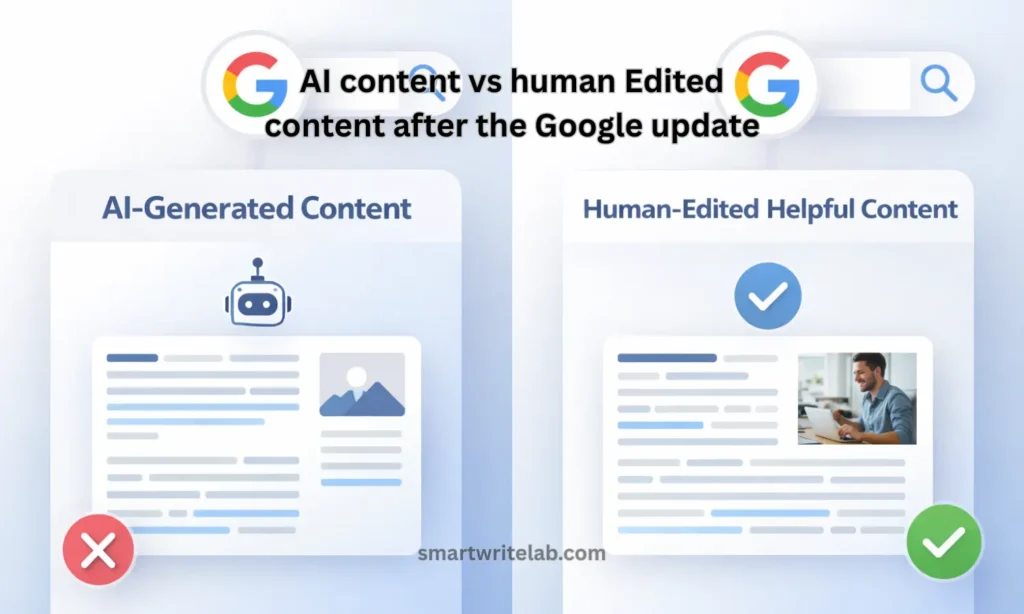
Helpful Content Update vs Traditional SEO Content
| Old SEO Approach | Helpful Content Approach |
|---|---|
| Keyword-focused writing | User-focused writing |
| High volume publishing | Selective, quality publishing |
| Generic explanations | Clear guidance |
| Automation without editing | Human-edited AI assistance |
| Content for ranking | Content for understanding |
This update reflects a long-term shift—not a temporary change.
What Google Considers “Helpful” Content
Based on Google’s documentation and observed behavior, content is considered helpful when:
- It answers the user’s question clearly
- It reduces confusion, not increases it
- It shows an understanding of the topic
- It feels written by someone who knows the subject
A good test is simple:
Would a user feel confident acting on this information?
If yes, the content aligns with the Helpful Content Update.
What to Do If Your Site Is Affected
If your site shows signs of low value (impressions without clicks, ranking drops):
Do NOT:
- Panic delete content
- Rewrite everything at once
- Publish more low-quality posts
Do This Instead:
- Identify your top impression pages
- Improve 20–30% of the content
- Add clarity, examples, and guidance
- Remove repetitive or unnecessary sections
Google responds better to improvements than removals.

Helpful Content Update and New Websites
For new websites, this update is actually an advantage.
New sites are not competing on backlinks or authority yet—so content quality matters more.
If you:
- Focus on one clear topic
- Write for a defined audience
- Avoid shortcuts
Google gives new sites room to grow.
Final Thoughts
The Helpful Content Update is not a punishment system—it is a quality filter.
Google is not against AI.
Google is against content that adds no real value.
If your content:
- Explains clearly
- Guides users
- Shows understanding
- Feels human
Then it is aligned with Google’s long-term direction.
Focus less on “ranking tricks” and more on helping the reader.
That approach remains future-proof—even in the age of AI.
Frequently Asked Questions (FAQs)
Is the Helpful Content Update permanent?
Yes. It is part of Google’s core ranking systems.
Should AI content be removed?
Only if it is genuinely unhelpful. Improving content is usually better.
Can one bad article affect the whole site?
Yes, if it reflects a repeated pattern.
How long does recovery take?
Typically, 2–6 weeks after meaningful improvements.
Is this update bad for bloggers?
No. It benefits bloggers who focus on quality over volume.