
Keyword Research for a New Blog (Step-by-Step Guide)

If you started a new blog and are not getting traffic, the problem is often not content quality.
It’s keyword selection.
Most beginners write articles first and think about keywords later. But in reality, keyword research for a new blog should happen before you publish anything.
This guide explains:
- How keyword research actually works for new blogs
- Which keywords to target
- What to avoid
- A realistic strategy that works without backlinks
This is a practical, beginner-focused tutorial — not theory.
Why New Blogs Don’t Get Traffic (Real Reasons New Bloggers Miss)
Table of Contents
Why Keyword Research for a New Blog Is Different
Large websites can rank for competitive keywords because they already have:
- Authority
- Backlinks
- Trust signals
- User history
A new blog has none of that.
So your keyword research strategy must be different.
If you target:
- High-volume keywords
- Broad topics
- Generic phrases
You will likely rank on page 3–5 and get no traffic.
For a new blog, keyword research means:
Finding small opportunities that big websites ignore.
Step 1: Understand Search Intent Before Keywords
Before looking at tools, understand search intent.
Every keyword falls into one of these categories:
- Informational (how, what, why)
- Comparison (vs, best, alternatives)
- Review (tool reviews, product feedback)
- Problem-solving (“why X happens”)
New blogs rank faster when targeting:
- Problem-solving keywords
- Comparison keywords
- Long-tail informational queries
Avoid:
- Broad educational terms
- Single-word keywords
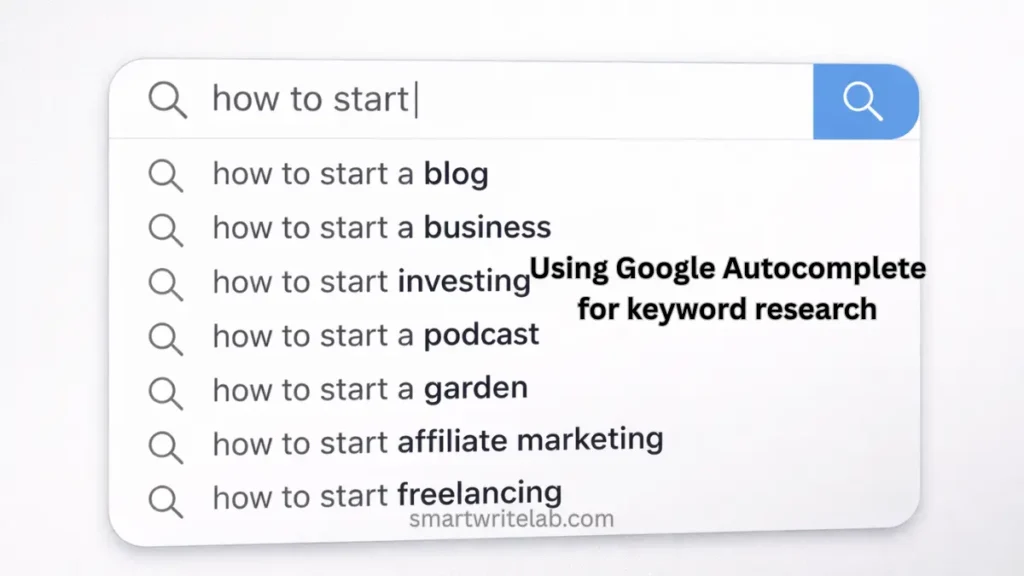
Step 2: Use Google Autocomplete (Free & Powerful)
Go to Google and type your topic slowly.
For example:
Instead of typing:
blogging tips
Type:
why new blogs…
Google will auto-suggest phrases like:
- Why new blogs don’t get traffic
- Why new blogs fail
- Why new blogs take time to rank
These suggestions come from real searches.
That means:
👉 There is demand.
Helpful Content Update Explained: Can AI Content Still Rank on Google?
Step 3: Analyze Search Results Manually
This step is where most beginners fail.
After choosing a keyword, search it.
Ask yourself:
- Are small blogs ranking?
- Or only big authority sites?
- Is the content shallow or deep?
- Can you create something clearer?
If page one is full of:
- HubSpot
- Forbes
- Wikipedia
Avoid that keyword for now.
Look for keywords where:
- Smaller blogs rank
- Forums appear
- Reddit shows up
That indicates lower competition.
Step 4: Check Keyword Difficulty (But Don’t Obsess)
Tools like:
- Ubersuggest
- Ahrefs (if available)
- Semrush
- Low-cost keyword tools
show keyword difficulty (KD).
For new blogs:
- KD under 20 → ideal
- KD 20–30 → possible
- KD above 35 → risky
But remember:
KD is only an estimate. Manual SERP check is more important.

Step 5: Target Long-Tail Keywords First
This is critical.
Instead of:
SEO tips
Target:
SEO tips for new blogs with no backlinks
Instead of:
AI tools
Target:
AI tools to improve Google rankings without backlinks
Long-tail keywords:
- Have less competition
- Match clear intent
- Convert better
- Rank faster
This is how new blogs grow safely.
Best AI Tools to Improve Google Rankings Without Backlinks
Step 6: Create a Keyword Cluster Strategy
Do not publish random articles.
Create clusters.
Example:
Main topic: Blogging Traffic
Cluster articles:
- Why new blogs don’t get traffic
- How long does it take for a new blog to rank
- SEO for new blogs with no backlinks
- Blogging mistakes beginners make
All articles internally link to each other.
This builds topical authority.
Google understands:
“This site deeply covers beginner blogging problems.”
Step 7: Avoid These Common Keyword Research Mistakes
Mistake 1: Chasing High Volume
High volume usually means high competition.
Mistake 2: Ignoring Intent
If intent doesn’t match your article type, traffic won’t convert.
Mistake 3: Writing Before Research
Never write first and assign a keyword later.
Mistake 4: Targeting the Same Keyword Repeatedly
Cannibalization kills new blogs.
Realistic Expectations for New Blogs
After proper keyword research for a new blog:
Month 1:
- Few impressions
Month 2–3:
- Ranking on page 2–3
Month 4–6:
- First consistent traffic
Growth is slow but compounding.
Best AI SEO Tools for Bloggers: Free Tools That Actually Work
A Simple 30-Day Keyword Research Plan
Week 1:
- Find 20 low-competition keywords
- Validate with SERP check
Week 2:
- Publish 2–3 high-quality long-tail articles
Week 3:
- Improve internal linking
Week 4:
- Update best-performing article
Repeat.
Consistency > speed.

Final Thoughts
Keyword research for a new blog is not about finding “big” keywords.
It’s about finding:
- Underserved questions
- Clear intent
- Low-competition phrases
If you focus on long-tail, problem-solving keywords and build clusters, your new blog can grow — even without backlinks.
Traffic doesn’t come from publishing more.
It comes from publishing smarter.




Nice Information Thank You